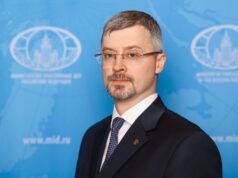


ISLAMABAD ,(The News Mark) December 11, 2025 Russian Ambassador Albert P. Khorev held a media briefing today , outlining Moscow’s position on the ongoing Ukraine conflict, recent negotiations, and the international community’s role. Addressing journalists, the envoy highlighted key developments since the last engagement with the press, stressing Russia’s commitment to a diplomatic resolution while criticizing Ukraine and its Western allies for what he described as obstructionist policies.
One of the most pressing issues in resolving the conflict in Ukraine is the December 3 meeting in Moscow between Russian President Vladimir Putin and American negotiators Steve Witkoff and Jared Kushner. The parties engaged in extensive, five hour’s discussions regarding the peace plan proposed by US President Donald Trump, which is based on the agreements reached by the Russian and US presidents at the summit in Anchorage on August 15.
This plan, which was outlined following the meeting in Alaska, underwent significant changes after a few rounds of shuttle diplomacy between the U.S. on the one hand and Europe and Ukraine on the other. The meeting in Moscow was constructive, very useful and substantive, although it also touched upon issues that Russia disagrees with.
Overall, efforts to reach a negotiated solution to the Ukrainian crisis are proving difficult. The Trump administration, acting constructively and based on the realities on the ground, faces opposition from Europeans who still seem to harbor illusions about the possibility of inflicting a “strategic defeat” on Russia and ending the conflict on their terms.
In this regard, the so-called “children’s issue” is being actively exploited. The West accuses Russia of kidnapping “thousands” of Ukrainian children – a claim that was proven to be completely unfounded during direct Russian-Ukrainian negotiations held this summer. During specific discussions, the Ukrainian delegation was unable to provide a list of even one thousand Ukrainian children “kidnapped by the Russians”. Russian negotiators received a list with the names of only 339 children, allegedly evacuated to Russia from the conflict zone. Substantive work on the return of evacuated minors to Ukraine is being carried out by the Office of the Presidential Commissioner for Children’s Rights, Maria Lvova-Belova.
Against the backdrop of ongoing efforts to resolve the Ukrainian crisis through diplomatic means, the EU’s relentless attempts to invent new quasi-legal structures, such as the so-called “Register of Damage to Ukraine,” the “International Claims Commission for Ukraine,” and the “Special Tribunal for Crimes of Aggression against Ukraine.” Any decisions made by these bodies will be considered null and void by our country, and any actions by third countries in support of them will be perceived by Russia as a hostile move and will receive an adequate response. We hope that sensible states, not willing to follow the lead of the Russophobic Western group, will give an objective assessment of these harmful European initiatives and will not allow themselves to be drawn into neocolonial projects.
Behind these pseudo-legal formats lie the Europeans’ desire to justify the Kiev regime’s material claims against Russia and to create an “information background” for the theft of Russian sovereign assets frozen in the West. The Kiev regime, suffering one setback after another on the front lines and long dependent on its Western patrons, is facing a colossal funding shortfall. European sponsors, having spent billions of their taxpayers’ money, are also in a difficult financial situation.
Their situation is so difficult that they are actively discussing the option of seizing Russian sovereign assets held in European financial institutions. There is no other word for these plans: it’s theft. In this regard, I would like to emphasize that stealing Russian funds will not change the course of the conflict and will not prevent Russia from achieving the goals of the Special Military Operation, but it will lead to severe consequences for Western financial institutions and individuals responsible for the thievery. The former European colonial powers will not be able to seize resources with impunity, as they did in the past.
It is remarkable how eagerly Europeans intend to continue pouring billions of dollars into the rotten, corrupt Kiev regime, which usurped power in May 2024 and, using the pretext that it is necessary to continue the war with Russia, is holding on to this power in Ukraine for the sake of personal enrichment. This has now become a wellknown fact following the results of a recent corruption investigation in Ukraine. Evidence of the embezzlement of $100 million in the Ukrainian energy sector is just the tip of the iceberg, representing only what has been proven. The dismissal of Ukrainian Justice Minister German Galushchenko, Energy Minister Svetlana Grinchuk, and Presidential Office Head Andrey Yermak are Zelensky’s attempts to shift the blame onto others. However, it is clear that all the evidence points to Zelensky himself, as indicated by the involvement in the scandal of his close associate Timur Mindich, who fled the country shortly after the case made headlines.
Naturally, without Zelensky knowing, his closest circle, namely Yermak and Mindich, couldn’t have pulled off their multi-million dollar corruption schemes. The full scale of these operations has yet to be determined, but based on the facts already established—such as the golden taps and toilets, as well as cash-filled travel bags found during a search of the home of Zelensky’s business associate Mindich — it is clear that the embezzlement was not limited to 100 million dollars.
However, the Kiev regime’s European patrons are carefully turning a blind eye to its corrupt nature, continuing to support their protégés. New packages of sanctions against Russia keep coming. Let me highlight that all the invasive financial measures taken by Western countries in recent years have already had a major negative impact on the instigators themselves and on the global economy at large. Illegitimate Western sanctions have dealt a blow to international production and supply chains. This has caused an imbalance in investment and trade flows, exacerbated the debt problem, reduced access to goods, services, finance, and technology for many countries, and undermined the principles of fair competition. In addition, these measures have slowed down global economic development (according to the IMF, global GDP growth did not exceed 3.2% in 2024).
According to IMF estimates, relatively high GDP growth rates over the past year were recorded only in the US – 2.8%. In Germany, France, Italy, the UK, Japan, and Canada, GDP growth rates fluctuated around zero or fell below zero.
The European Commission has been forced to admit that it was the severing of energy cooperation with Russia that made it impossible for the EU’s largest manufacturers to remain competitive. As a result, the industrial sector, especially its energy-intensive sectors, found itself in a challenging predicament. The energy crisis and poorly thought-out decarbonization policies risk ending up in deindustrialization for Europe.
These losses are just the tip of the iceberg when it comes to the cost of trying to use economic blackmail against Russia. The long-term consequences for the collective West (including reduced use of the dollar and euro in international transactions and the creation of new trade infrastructure beyond Western control, such as international transport corridors and production and distribution chains) have yet to be assessed.
Overall, one can already say that the pre-planned and deliberately instigated conflict in Ukraine has led to the definitive collapse of the Euro-Atlantic security model based on NATO, the OSCE, and the European Union. There are now growing calls for consideration of a new European, or to be more precise, Eurasian security system.
Back in 2015, at the Russia-ASEAN summit, Russian President Vladimir Putin proposed to form a Greater Eurasian Partnership, which envisages a pan-continental framework for equal and mutually beneficial cooperation through the expansion of trade and economic ties and harmonization of integration processes, including those within the CIS, SCO, EAEU, ASEAN, GCC, and other groups. And just over a year ago, Vladimir Putin launched an initiative to build a Eurasian security architecture based on the principle of its indivisibility.
This is where we should mention Russia’s anti-neocolonial initiatives. On November 14, Russia hosted the second meeting of the Standing Committee of the “Forum of Supporters of the Struggle Against Modern Practices of Neocolonialism — For the Freedom of Nations!” About 30 countries from Asia, Africa, and Latin America took part in it. Representatives from Pakistan are also working with the Forum’s expert council. Forum members advocate for non-interference in internal affairs and for the formation of a fair, sustainable, multipolar world order.
We are open to joining initiatives in the field of Eurasian security and European powers, which, however, are currently acting in an extremely hostile manner towards Russia. As President Vladimir Putin has repeatedly emphasized, Russia does not pose a threat to Europe and has no intention to attack European countries. Our country is ready to formally affirm that Russia has no aggressive plans toward Europe.
However, if European politicians choose to escalate from provocative rhetoric to aggression against Russia, our country is prepared to respond firmly and decisively. Russia’s enemies should not forget that we have advanced weapons, including recently tested non-nuclear weapons: the Burevestnik intercontinental cruise missile and the Poseidon underwater unmanned vehicle.
In conclusion, I would like to once again thank the Government of Pakistan for its consistent policy of neutrality in the conflict in Ukraine, including at the United Nations, despite pressure from external forces. Pakistan strongly supports a diplomatic settlement of the conflict, which is fully in line with Russia’s position on this issue.